SHARE


What is domain infringement?
Domain infringement, also known as domain name infringement, occurs when a third party registers, uses, or sells a domain name that’s confusingly similar to a protected brand or business name without authorization.
How domain trademark infringement differs
A specific form of domain infringement is domain trademark infringement that occurs when a domain unlawfully uses a registered trademark in a way that confuses or weakens brand identity. Organizations can address these cases through Uniform Domain Name Dispute Resolution Policy (UDRP) complaints, trademark enforcement, or legal action.
However, not all domain disputes involve trademarks. Some types of infringing content may not contain a trademark but still pose security and brand risks.
What every business should know about cybersquatting and other common types of infringement
Bad actors exploit domain names in various ways—whether to profit from a brand’s identity, deceive consumers, or distribute malicious content. Here are some of the most common tactics businesses should be aware of:
- Cybersquatting, also known as domain squatting, is when someone registers a domain to profit from a brand’s identity. The cybersquatter, or domain squatter, may attempt to sell it to the rightful brand owner at an inflated price. For example, a domain squatter might register “BrandName.com,” with the intention of selling it to the legitimate company.
- Combosquatting is a subtype of cybersquatting that involves adding extra words to a brand name, such as, “BrandName-Shop.com.”
- Typosquatting relies on misspelled domains to deceive customers instead of directing them to the expected location. In this scenario, the bad actor registers a misspelled variant like “BrnadName.com” so that it receives traffic whenever customers accidentally mistype the name.
- Domain name extension exploitation occurs when cybercriminals exploit domain ends like .COM or newer options like .XYZ to trick users, spread malware, or impersonate brands. They often target low-cost or poorly regulated extensions to evade detection, putting businesses and their customers at risk.
- Domain parking is the practice of owning a registered domain without actively using it for a website or email. Brand owners often engage in legitimate domain parking by registering defensive domains to secure future projects or prevent impersonation. However, third parties can also park domains for less legitimate purposes, holding them for later use in hosting ads, redirecting traffic, or launching phishing campaigns.
Domain spoofing tactics
Domain spoofing is a deceptive tactic where cybercriminals create fake domains resembling legitimate ones to mislead users, often for phishing or fraud purposes.
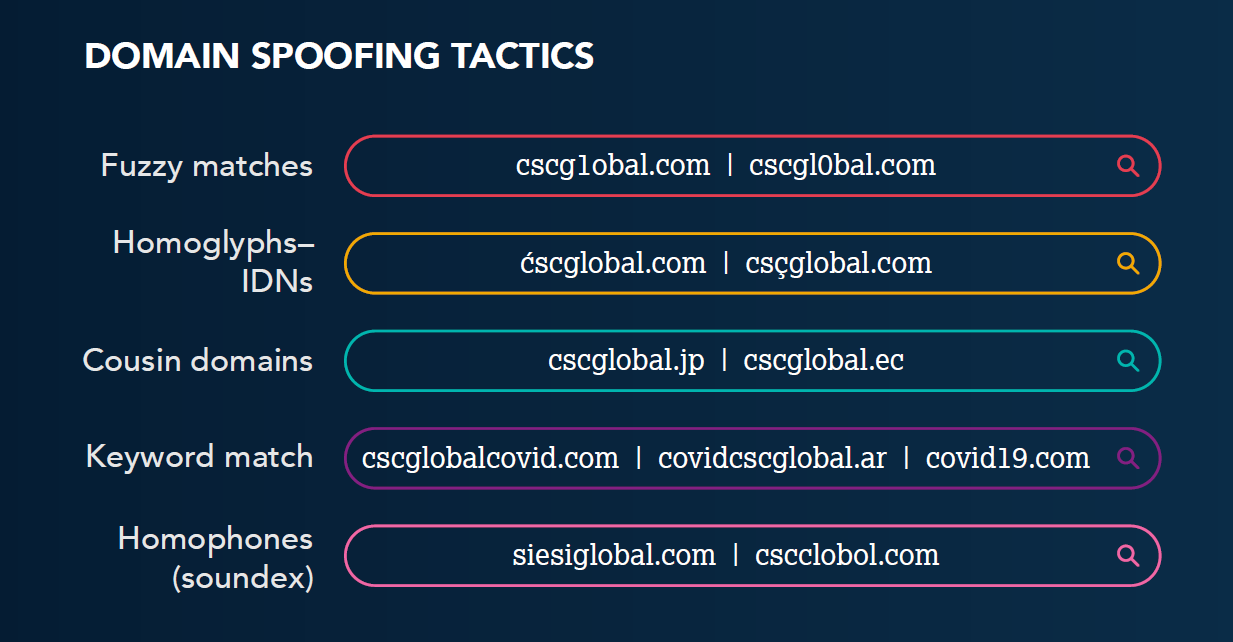
Domain spoofing tactics
Fuzzy matches
Homoglyphs-IDNs
Cousin domains
- Keyword match
- Homophones
There are endless domain spoofing tactics and permutations that phishers and malicious third parties can use to register variants of your brand. Some illegitimate registrations aim to exploit customers' trust in a targeted brand, enabling phishing schemes, digital brand misrepresentation, or intellectual property (IP) infringement that result in revenue loss, diverted traffic, and damage to the brand's reputation.
Examples of domain spoofing
Some common methods include:
- Fuzzy matches – Altering or omitting a small part of a brand name.
- Homoglyphs – Replacing letters with visually similar characters, like using a Cyrillic “ɑ” instead of a Latin “a.”
- Cousin domains – Using variants that add familiar industry terms, such as BrandName-Support.com, to appear credible.
- Keyword match – Incorporating brand-related terms, such as BrandNameDiscounts.com.
- Homophones – Using words that sound the same but are spelled differently, like BranedName.com, to exploit phonetic confusion.
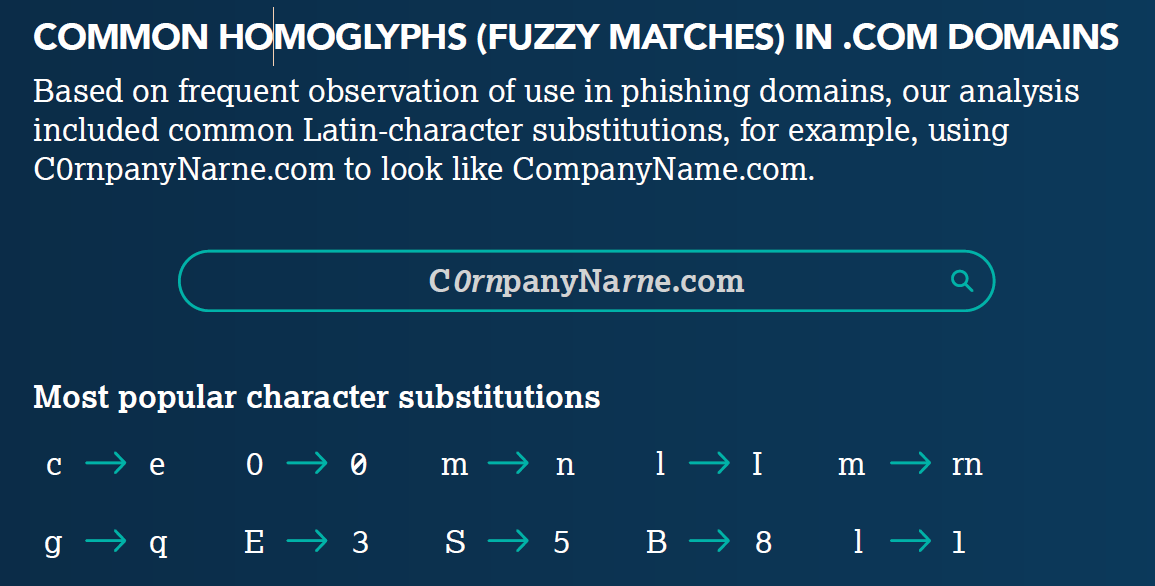
Common homoglyphs (fuzzy matches) in .com domains
Based on frequent observation of use in phishing domains, our analysis included common Latin-character substitutions, for example, using C0rnpanyNarne.com to look like CompanyName.com
Most popular character substitutions
c to e
O to 0
m to n
1 to I
m to rn
g to q
E to 3
S to 5
B to 8
l to 1
Impact of domain name infringement
Domain names are central to the identity of most businesses today. Strong domain protection and monitoring strategies can significantly reduce the likelihood of your IP being exploited on the web. But when unauthorized use does occur, domain infringements can have rapid, far-reaching, negative impacts.
A domain name that has been infringed upon can lead to traffic diversion, customer confusion, the sale of counterfeit goods, phishing attacks, and even the distribution of malware.
For large enterprises, the consequences of domain infringement go beyond lost revenue and brand dilution. Misuse of a company’s domain can expose organizations to legal liability, regulatory penalties, and disruptions to operations, especially in highly regulated industries such as healthcare, finance, and technology. Fraudulent domains can enable phishing schemes that lead to data breaches, violating privacy laws and triggering costly compliance failures.
Regulatory and compliance risks
Companies operating in regulated sectors must adhere to stringent data protection, financial security, and consumer safety regulations. Failure to prevent domain-related security incidents can result in audits, fines, and legal penalties. Key frameworks include:
- Health Insurance Portability and Accountability Act (HIPAA)
- Payment Card Industry Data Security Standard (PCI DSS)
- General Data Protection Regulation (GDPR)
By treating domain protection as a compliance necessity, enterprises can reduce exposure to regulatory fines, legal actions, and reputation damage while safeguarding their brand’s digital assets.
How to avoid domain name infringement
Legitimate brand owners may register multiple domains that include their brand that they may never actively use online. These defensive domains are precisely for preventing third parties from abusing their brand in domains and it’s an essential component of healthy domain management.
An enterprise-level registrar like CSC offers 3D Domain Security and Enforcement services to help brands balance security and brand protection against costs and administrative work.
Tools for protection against infringement
Because there is an almost endless combination of potential domain names available, relying on just domain portfolio management may not be enough. There are many AI-powered monitoring and detection cyber solutions available that actively scan for domains that infringe on your trademarks, brand names, or IP. For additional security, enterprises should consider a layered enforcement strategy that includes takedown services, and when necessary, legal action.
A solution like ours provides real-time analysis and alerts when potential infringements are detected and prioritizes threats based on risk levels.
However, automated monitoring and AI detection can generate a high volume of false positives, which can further complicate efforts to filter out illegitimate registrations. Our solution enhances accuracy by combining advanced technology with our domain analysts who review flagged domains to ensure efficient processes and precise enforcement when protecting your brand.
How to resolve a domain dispute
When a domain infringes on your brand, several enforcement options are available, depending on the nature of the infringement. Common approaches include:
- UDRP – A well-established process for recovering or canceling infringing domains across generic top-level domains (gTLDs) and select country-code top-level domains (ccTLDs).
- Dispute Resolution Policy (DRP) – Used for challenging ownership of infringing domains under specific ccTLDs that don’t fall under UDRP jurisdiction.
- Uniform Rapid Suspension (URS) – A fast-track option for clear-cut cases, temporarily suspending infringing domains under certain gTLDs.
- Domain acquisition – Obtaining the domain is sometimes the most effective approach. A domain brokerage team can facilitate negotiations on your behalf.
Our Dispute and Recovery solutions help enterprises navigate these enforcement options with expert guidance. CSC is the top UDRP filer with the World Intellectual Property Organization (WIPO), achieving a 99% success rate. As a trusted provider for some of the world’s largest brands, we assess your case, determine the best course of action, and take approved enforcement steps to help you reclaim or secure your digital assets. For additional protection, consider using a brand and phishing takedown service.
Frequently asked questions (FAQ)
Yes. A domain name can infringe on a trademark if it’s used in a way that creates consumer confusion, misleads users, or takes advantage of an established brand’s reputation. A trademark owner may enforce trademark rights against domain infringers through legal action and domain monitoring solutions.
Businesses should conduct thorough research before purchasing a domain.
- Search databases like the United States Patent and Trademark Office (USPTO) and the WIPO for existing trademarks.
- Confirm if similar domains are already in use to prevent any potential infringement issues.
- Work with legal teams and business experts to ensure your compliance with any trademark infringement laws.
Protecting your company’s brand online is critical to preventing domain infringement, which can lead to attacks that can harm your bottom line and reputation. When bad actors misuse a company’s name, they can mislead customers, leading to lost trust and legal liabilities. Proactive monitoring and enforcement help safeguard a company’s digital presence and ensure long-term business integrity.
Companies facing domain name infringement can resolve disputes using the ICANN UDRP process, trademark lawsuits, or Anticybersquatting Consumer Protection Act (ACPA) claims. Legal actions range from cease-and-desist letters to court proceedings, depending on the severity of the violation. While registrars do not provide legal services, some can assist with the administrative process of UDRP filings, domain recovery efforts, and enforcement actions, helping organizations navigate domain disputes more efficiently.
Enterprises often use domain monitoring solutions, brand protection services, and AI-powered detection and enforcement tools. These solutions can continuously scan for homoglyphs, homophones, and fuzzy matches.
Industries with high brand visibility, who rely on deep customer trust, and often hold substantial amounts of customer data within customer portals—such as finance, eCommerce, pharmaceuticals, and technology companies—are frequent targets of typosquatting sites, combosquatting domains, and trademark infringement on the web.
Related resources

CSC's 2024 Domain Security Report Finds Drop in Healthcare Domain Security Despite Increase in Prominent Cyber Attacks

CSC's 2023 Domain Security Report Finds Many Global 2000 Companies Neglect their .AI Domain Extensions Despite Surge in Popularity for Artificial Intelligence
VMBlog, October 17, 2023
2022 CSC Domain Security Report Finds Nearly Three Quarters of Global 2000 Companies are at Alarmingly High Risk of Exposure to Security Threats

Tackling Domain Name Infringements

Domain Names Can Infringe Trademarks
Make an inquiry
All fields marked with * are required.